Why You Feel "Behind" (It’s Not You, It’s Your Hierarchy)
A lot of people come to feel as though they lack confidence, status, or charisma.
In my experience, many of them are simply being evaluated by the wrong system.
Not all hierarchies measure the same thing. There is a confusion about confidence, visibility, and success.
People feel behind despite their effort and discipline. In many cases, it’s a mismatch of environments rather than a character deficiency.
Hierarchies as a Neutral Concept
Hierarchies exist everywhere, throughout nature and human society. In life, we will experience different social, professional, and personal hierarchies. The issue is not hierarchy itself. The problem is what behaviors are rewarded.
There are two models of hierarchies:
status-driven
and reality-based.
Status-Driven Hierarchies
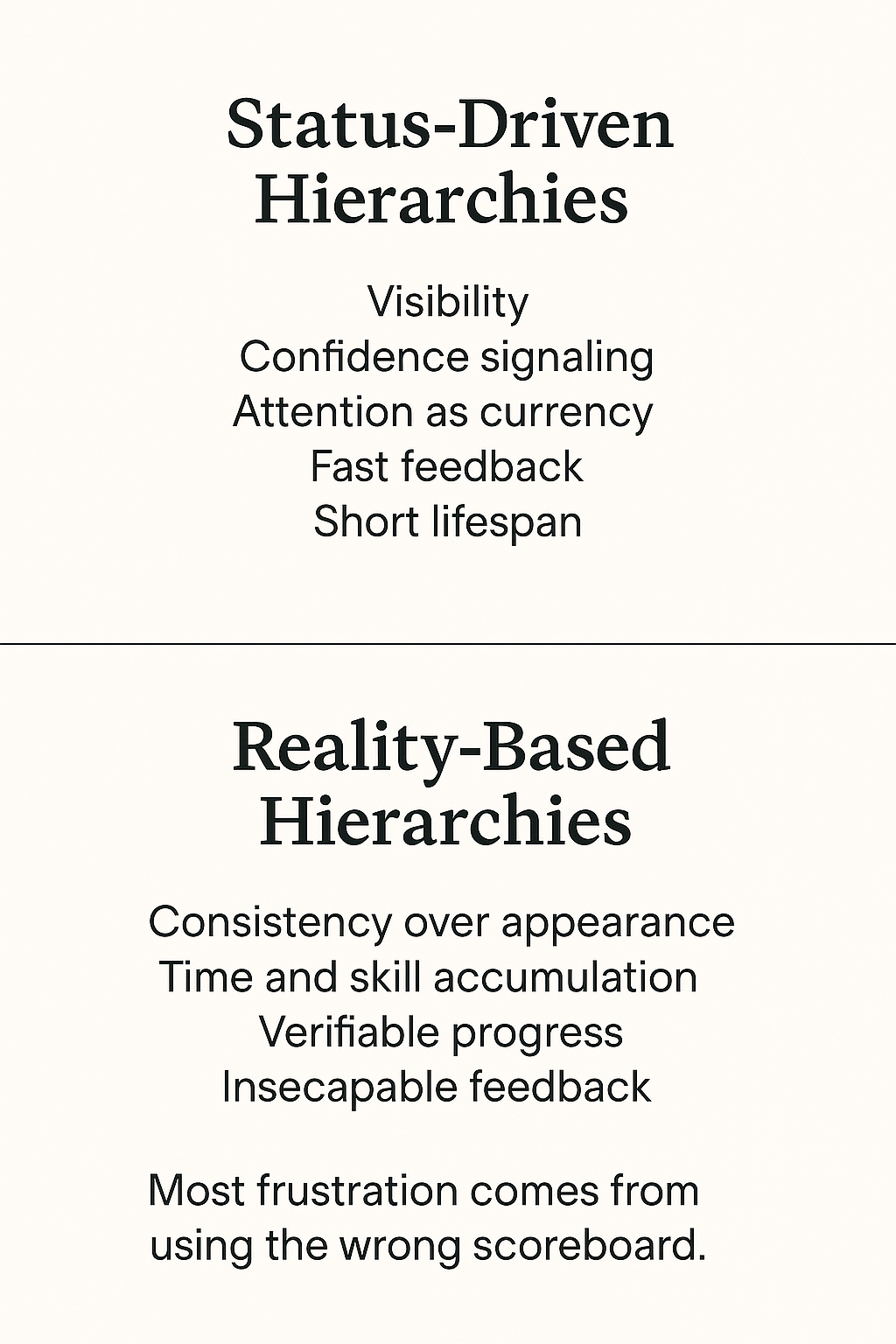
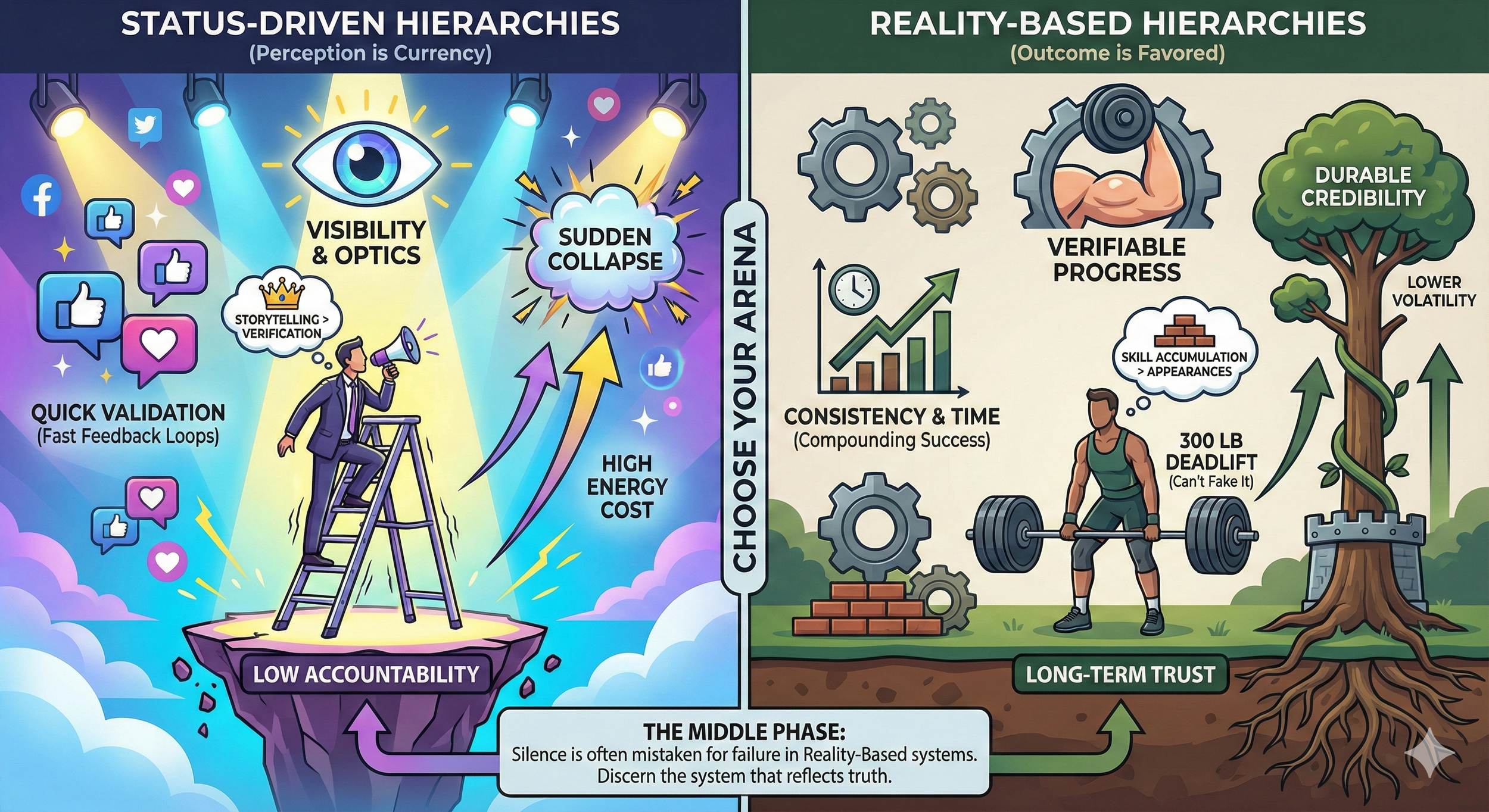
In status-driven hierarchies, perception often functions as currency and visibility is heavily prioritized. People use confidence signaling to show presence and impression management.
Narrative and storytelling tend to carry more weight than verification.
Attention equals value.
Fast feedback.
Attention and validation is quickly won over. However, it is not long-lasting or meaningful in the long-term.
Where Status-Driven Hierarchies Appear
They will be found in image-forward professional spaces. Networking will be built on optics. The social environments are built with fluid participants. The contexts are dominated by first impressions. These spaces often have weaker long-term accountability.
Strengths of Status-Driven Systems
These systems do have strengths. Firstly, there is rapid momentum. Many benefit through social lubrication and there are first contact advantages. People can gain quick access to attention in these environments. There are low-entry barriers.
Limits of Status-Driven Systems
They require constant reinforcement. There can be sudden collapse when the context changes. It is difficult to compound and there is shallow conversion into stability. Status-systems have a high energy cost over time.
Reality-Based Hierarchies
In reality-based hierarchies:
Outcome is favored over appearances.
Consistency is rewarded.
Time is a factor and it involves skill accumulation.
A benefit is that self-regulation is required. There is verifiable progress and inescapable feedback.
Where Reality-Based Hierarchies Appear
Training and fitness are clear examples of reality-based hierarchies. A 300 lb deadlift is difficult to fake. Another is education and credentials, as is healthcare and technical fields. Craft-based work is also where they are found. Reality-based hierarchies also involve roles with long memory. These environments are resistant to narrative.
Strengths of Reality-Based Systems
It is harder to fake success in reality-based systems. Progress compounds and establishes durable credibility. There is long-term trust as time progresses. Lastly, there is lower volatility.
Costs of Reality-Based Systems
A huge one is delayed recognition and less early visibility. Early progress is quiet and often goes without much fanfare or mass attention. There is also a middle phase ambiguity where the hard work is there but the rewards haven't caught up. This is often misread as lack of momentum.
Psychological Friction
There is friction for discipline-oriented people in perception-heavy spaces. As there is for performance-oriented people in accountability heavy spaces. For many, there is anxiety from misalignment. Self-doubt can be triggered by wrong metrics. Silence is sometimes mistaken for failure.
The Middle Phase
We have an early optics vs late substance divide. There can be a comparison peak. People have a temptation to abandon the long game. In reality based-systems, people misinterpret the absence of praise. Short-term reward biases often show up in status-driven systems.
Arena Choice
The environment shapes which traits surface. What determines the scoreboard is the arena. Opting out of one system can be used for alignment. Exposure must be weighed vs. the right fit. Whether there is an energy gain vs depletion, this will determine the right fit.
Practical Reflection Filters
Some useful things to think about:
effort to outcome ratios
how fakeable progress is
visibility versus consistency
regulation versus drain
short-term versus long-term measurement
Closing Perspective
To reiterate, hierarchy is inevitable. Discernment must be used over judgment. We have to choose systems that reflect reality. Status must be evaluated vs long-term trajectory.
Which system is actually giving you the most accurate feedback?