What Astrology Can — and Cannot — Explain
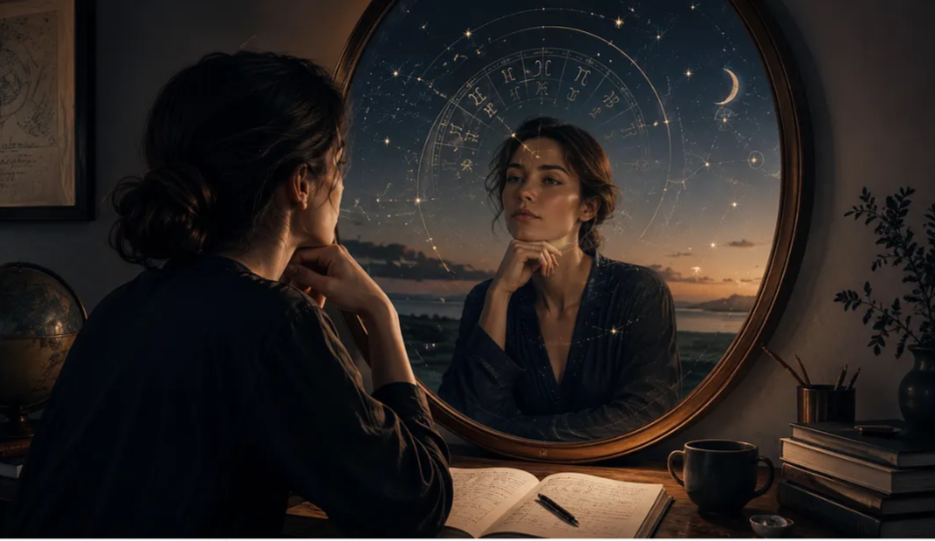
This image was created with assistance from AI.
A grounded case for using astrology as symbolism without mistaking it for science
Astrology occupies an unusual place in modern culture. It is ancient but endlessly adaptable, mystical but filled with calculations, and dismissed as irrational even as millions of people continue to find it personally meaningful.
I understand the attraction. Astrology offers an elaborate vocabulary for interpreting personality, conflict, desire, timing, and change. It can make an ordinary experience feel connected to something larger. A difficult period becomes a Saturn transit. An assertion of confidence feels Martian. A conflict between restraint and desire becomes an opposition between two planets.
The language is vivid, memorable, and often psychologically evocative.
But evocative is not the same as objectively true.
That distinction matters because astrology can function in two very different ways. It can be used as a symbolic framework that encourages reflection, or it can be treated as a literal system that determines personality and predicts events. The first can be creative and illuminating. The second makes claims that astrology has not reliably demonstrated.
The Appearance of Precision
Part of astrology’s persuasiveness comes from its technical complexity.
A complete astrological reading may involve planets, signs, houses, aspects, degrees, rulerships, dignities, transits, progressions, annual profections, time lords, lunar returns, and dozens of other techniques. The vocabulary creates an impression of rigor. A birth chart looks more like a technical diagram than a simple fortune.
But precision alone does not establish truth.
A system can calculate the exact position of Mars at the moment of someone’s birth without proving that Mars shaped that person’s temperament. The astronomical calculation may be accurate while the psychological interpretation remains speculative.
Controlled research has not established that astrologers can reliably match birth charts to personality profiles at rates exceeding chance. In a well-known double-blind test published in Nature, astrologers’ chart interpretations did not perform as astrology predicted. A later study found that participants could identify genuine personality-test profiles better than chance but could not reliably identify their authentic astrological profiles.
This does not prove that every astrological experience is meaningless. It does mean that personal resonance should not be mistaken for scientific validation.
Why Astrology Still Feels Accurate
Astrology often works through interpretation rather than measurement.
Descriptions such as intense but private, independent yet sensitive, confident in some situations but insecure in others, or loyal until betrayed can apply to many people. They feel personal because they describe genuine human tensions.
We also participate in creating the meaning.
When a description fits, we remember the match. When it does not fit, we may reinterpret the placement, introduce another aspect, change house systems, consult a progression, or decide that the quality is latent rather than visible. The system is flexible enough to absorb contradiction.
That flexibility makes astrology useful as storytelling, but weakens it as a testable explanatory system.
If a supposedly weak Mars can signify weakness, suppressed strength, strength developed through adversity, hidden aggression, spiritual courage, or delayed assertiveness, almost any outcome can be explained after it occurs. The interpretation may still be interesting, but it is no longer making a clear prediction.
A framework that can accommodate every possible result cannot easily demonstrate when it is wrong.
The Problem With Astrological Hierarchies
Traditional astrology often ranks placements through concepts such as rulership, exaltation, detriment, fall, beneficence, and maleficence.
These categories have historical and symbolic value, but they can become psychologically harmful when treated as verdicts about human worth.
A person may begin to think of themselves as deficient because a planet is described as debilitated. Someone else may decide that a supposedly powerful placement proves natural superiority. Ordinary personality differences become part of a celestial hierarchy: strong charts and weak charts, fortunate lives and damaged lives, chosen people and cosmically disadvantaged ones.
That is too much authority to give a symbolic system.
No zodiac sign owns courage, vanity, intelligence, sensuality, discipline, emotional depth, aggression, or creativity. These are human capacities shaped by temperament, biology, family, culture, experience, opportunity, habits, and choice.
A Pisces Mars is not condemned to weakness. A Leo Sun is not guaranteed confidence. A Scorpio placement does not make someone profound, dangerous, sexual, or psychologically perceptive. An exalted planet does not make its owner more evolved.
The symbolism may inspire a useful question. It should not dictate the answer.
Astrology as a Reflective Language
Rejecting astrology as literal science does not require treating it as culturally worthless.
Human beings have always used stories, myths, archetypes, religious images, fictional characters, and symbolic systems to understand themselves. We often recognize something through metaphor before we can explain it analytically.
Astrology can work in the same way.
Mars can symbolize action, conflict, desire, courage, and anger. Saturn can represent limitation, responsibility, time, fear, and discipline. Venus can evoke attraction, pleasure, beauty, values, and relationship. These symbols can help organize reflection even if planets are not transmitting personality traits into newborn children.
The useful question is not necessarily:
What is Mars making me do?
It may instead be:
How do I currently handle anger, initiative, competition, and desire?
The chart becomes a prompt rather than a diagnosis.
A Saturn transit can serve as an invitation to examine responsibility and structure. It does not prove that Saturn caused a job loss, illness, breakup, or period of isolation. Scorpio symbolism can help someone explore themes of secrecy, intensity, vulnerability, and transformation. It does not establish that everyone born under Scorpio shares a fixed psychological essence.
Used this way, astrology resembles a structured imagination exercise. It offers images through which people can examine their lives without requiring them to believe that those images control reality.
Where Astrology Should Stop
A symbolic practice needs boundaries.
Astrology should not replace medical care, psychological assessment, legal advice, financial analysis, or evidence-based decision-making. It should not be used to diagnose strangers, declare someone dangerous, determine compatibility, excuse mistreatment, or predict unavoidable disaster.
It should not tell someone that they are doomed to poverty, loneliness, illness, violence, betrayal, or failure.
It should also not become a way of surrendering responsibility. A transit does not make someone send a reckless message, neglect their health, gamble money, remain in a destructive relationship, or avoid necessary work. Whatever symbolic atmosphere a person associates with the moment, decisions still have real-world causes and consequences.
A grounded approach gives reality the final vote.
When the symbolism conflicts with observable facts, the facts win. When an astrological interpretation creates fear, grandiosity, helplessness, or obsession, it has stopped being useful. When it encourages reflection while leaving room for evidence and personal agency, it can remain an enjoyable tool.
A Mirror, Not a Sentence
I no longer need astrology to provide a complete explanation of who I am.
A person’s life is better understood through biography, temperament, relationships, environment, opportunity, loss, discipline, mistakes, choices, and time. These forces are less glamorous than planetary destiny, but they are real — and many of them can be changed.
Astrology can still add symbolic texture. It can help frame a question, generate an image, or give language to a tension that was difficult to articulate. It can be part of creative practice, private reflection, or cultural conversation.
It simply should not be confused with proof.
A birth chart may operate as a mirror onto which we project meaning. Sometimes the reflection reveals something worth examining. But the mirror is not a command, a diagnosis, or a fixed map of the future.
The most grounded way to use astrology is to hold it lightly: appreciate its imagery, question its claims, notice what it brings to mind, and remain willing to put it down.
The planets do not need to authorize a meaningful life.
That remains something we build here on Earth.